

What Kids Actually Learn from Building Electronics Projects
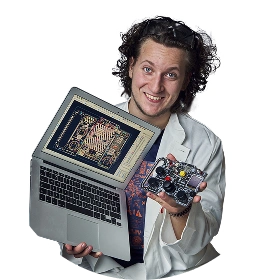
Read stories how our founder Albert turned his childhood passion into CircuitMess, and get exciting DIY project ideas you can do with your kids at home for free.
Table of content
Building electronics teaches kids three layers of skills simultaneously: technical knowledge (circuits, coding, components), thinking patterns (debugging, systems thinking, creative problem-solving), and life skills (patience, resilience, and the confidence that comes from making something real). Most parents buy electronics kits for the first layer. The second and third are what make the investment genuinely worthwhile.
This isn't theoretical. When a kid spends two hours assembling a CircuitMess Wheelson 2.0 robot car and it doesn't move, then systematically checks every connection until they find the loose wire - they've practiced the exact debugging process that professional engineers use daily. When they modify the robot's code to change its navigation behavior and the robot does something unexpected, they've experienced the iterative design cycle that drives all innovation.
The box says "electronics kit." What's inside is a crash course in thinking clearly under uncertainty.

Layer 1: Technical Skills (The Obvious Ones)
These are the skills parents expect when they buy an electronics kit. They're real and they matter - they're just not the whole story.
How Circuits Work
Every electronics build teaches the fundamentals of electrical circuits: current flows from a power source through connected components and back. Kids learn this not from a textbook but from experience - they connect a battery, a switch, and an LED, and the LED lights up. They disconnect one wire and it goes dark. The concept of a complete circuit becomes intuitive through repetition across dozens of connections during a single build.
More advanced kits introduce voltage regulation, sensor circuits, and communication protocols. A kid building the CircuitMess Chatter 2.0 learns that LoRa radio modules convert digital data into electromagnetic waves that travel kilometers without Wi-Fi - not because someone explains it, but because they build the device and send a message to a friend standing across a field.
Component Recognition and Function
After building one or two kits, kids can identify and explain common electronic components: resistors limit current, capacitors store charge, sensors convert physical phenomena (light, temperature, distance, motion) into electrical signals, microcontrollers process those signals and make decisions, and motors convert electrical signals back into physical movement.
This knowledge accumulates naturally. A kid who's built a CircuitMess Bit 2.0, then a Wheelson, then a Chatter, has handled dozens of different components across three distinct devices. They start recognizing patterns - "this looks like the sensor from my last kit, but this one reads distance instead of light."
Programming Logic
Every programmable electronics kit teaches coding fundamentals: variables (storing values like sensor readings), conditionals (if the distance is less than 20cm, turn left), loops (check the sensor every 100 milliseconds), and functions (a reusable block of code that handles motor control). These concepts are identical whether a kid learns them through CircuitBlocks, Scratch, Python, or C++.
What electronics kits add to coding education is context. In a screen-only coding environment, a variable is an abstract container. In an electronics project, a variable holds the actual reading from a temperature sensor or the current speed of a motor. Abstract concepts become concrete when they control physical objects.
Soldering (Advanced Kits)
The CircuitMess NASA Mars Rover requires hand-soldering over 300 components - a manual skill used throughout electronics manufacturing, repair, and prototyping. Soldering teaches fine motor control, temperature awareness, quality inspection, and an understanding of how permanent electrical connections are made. It's a genuine trade skill with practical applications well beyond hobbyist building.
Layer 2: Thinking Patterns (The Valuable Ones)
These skills don't appear on the box but they're what educators and researchers point to as the real long-term value of maker education. Studies consistently show that hands-on STEM activities develop critical thinking, problem-solving ability, and creative reasoning - skills that transfer across every academic subject and career path.
Systematic Debugging
When an electronics project doesn't work - and at some point, it won't - kids face a choice. They can get frustrated and give up, or they can systematically isolate the problem. Is it the code? Check if the code compiles. Is it a connection? Check each wire. Is it the component? Try a different one.
This process - forming a hypothesis about what's wrong, testing it, updating your understanding, trying again - is the scientific method applied to a practical problem. Research from maker education programs shows that kids who regularly build and troubleshoot electronics develop measurably stronger problem-solving skills than peers who learn only through instruction.
The critical insight is that electronics debugging is multidimensional. Unlike fixing code on screen (where the problem is always in the code), fixing an electronics project could be a wiring issue, a code error, a component failure, a power supply problem, or even an environmental factor. Learning to consider all possible causes and narrow down systematically is a thinking skill that applies to diagnosing car trouble, debugging a business process, or figuring out why a recipe didn't turn out right.
Systems Thinking
Electronics projects are systems - interconnected components where each part affects the whole. A sensor feeds data to a processor, which runs code that sends signals to motors, which create movement that the sensor then detects again. Changing any one part affects every other part.
Kids who build these systems develop an intuitive understanding of how interconnected components create emergent behavior. When a CircuitMess Wheelson 2.0 navigates a room, the kid understands it's not magic - it's a camera feeding images to a processor running code that controls motors. They can trace the cause-and-effect chain from physical input to digital processing to physical output.
This systems-level thinking is increasingly recognized as one of the most important skills for the 21st century. Complex problems - in business, medicine, environmental science, technology - are almost always systems problems where changing one variable affects many others. Kids who've built electronic systems have practiced this thinking in miniature.
Iterative Design
The maker education mantra is "plan, build, test, fix, repeat." Kids who build electronics internalize this cycle naturally. Their first attempt at programming the Wheelson's navigation might make it crash into walls. So they adjust the distance threshold. Now it stops too early. So they fine-tune the value. Eventually, it navigates smoothly.
This iterative process - trying something, evaluating the result, making targeted adjustments, trying again - is how every successful product, business, and creative work develops. It's also the opposite of how school traditionally works (study, take test, get grade, move on). Electronics kits let kids experience the more realistic cycle of continuous improvement that defines professional work.
Reading Technical Documentation
Building from instructions - following wiring diagrams, interpreting component labels, understanding schematic symbols - develops a specific literacy that's surprisingly rare and valuable. Kids who are comfortable reading technical documentation can teach themselves almost any technical skill, because the pattern is always the same: read the instructions, understand the components, follow the steps, troubleshoot when something doesn't match.
Layer 3: Life Skills (The Lasting Ones)
These are the skills that parents notice months or years later - not during the build itself, but in how their kid approaches challenges, setbacks, and new situations.
Productive Failure
STEM maker education research consistently shows that "failing is part of the process, and students learn that it's OK." Electronics projects create safe, low-stakes environments for kids to experience failure and recovery. When a circuit doesn't work, nobody gets hurt and nothing important breaks. The kid just has to figure out what went wrong and fix it.
Over time, repeated experience with productive failure changes a kid's relationship with mistakes. Instead of seeing failure as a final verdict ("I can't do this"), they start seeing it as information ("something isn't right yet - let me find it"). This mindset shift - from fixed to growth, in the language of educational psychology - affects everything from school performance to social resilience.
Self-Efficacy and Confidence
There's a specific kind of confidence that comes from building something that works. Not the confidence of being told you're smart, or getting a good grade - the confidence of holding a device you assembled from components and watching it do something impressive. A CircuitMess Clockstar 2.0 smartwatch on a kid's wrist that they built themselves is a daily reminder: "I made this."
This self-efficacy - the belief that you can figure things out - is one of the strongest predictors of academic and professional success. Kids who build electronics develop it through direct evidence: they faced a complex challenge and succeeded.
Patience and Delayed Gratification
In a world of instant digital feedback, building a physical electronics project is a rare experience of delayed gratification. The CircuitMess Mars Rover takes roughly 15 hours to complete. That's 20 hours of careful work before the rover moves for the first time. Kids who complete builds like this develop a tolerance for extended effort that serves them in every subsequent challenge - from learning a musical instrument to completing a college thesis.
Even simpler builds reinforce this. The CircuitMess Bit 2.0 takes a bit less than an hour to assemble. For a seven-year-old accustomed to instant app gratification, an hour of focused building before the game console turns on is meaningful practice in patience.
Communication and Explanation
Kids who build electronics can explain technology. They can tell you why the robot turns left when the sensor detects an obstacle, how the walkie-talkie sends messages without Wi-Fi, or what happens inside the smartwatch when it connects to a phone. This ability to explain technical concepts clearly is a communication skill that's valuable in every field - not just engineering.
How These Skills Show Up Later
The technical skills from electronics kits map directly to STEM education and careers. But the thinking patterns and life skills transfer much more broadly:
In school: Kids who've debugged electronics approach math word problems differently - they break complex problems into testable steps. They read science lab instructions more carefully. They're more comfortable with the trial-and-error process of writing essays and revising them.
In other activities: The patience developed through a 20-hour solder build transfers to learning an instrument. The systematic debugging mindset helps in sports strategy. The confidence from building something real shows up as willingness to try new, challenging activities.
In future careers: Whether a kid becomes an engineer, a doctor, a teacher, or an entrepreneur, the core skills - systematic problem-solving, systems thinking, iterative improvement, resilience after failure, clear communication of complex ideas - are universally valuable.

Frequently Asked Questions
Do electronics kits help with school performance?
Yes, though not always in the way you'd expect. The direct benefits appear in science and technology classes, where hands-on experience with circuits and programming provides concrete understanding of abstract concepts. The indirect benefits - improved problem-solving ability, stronger reading of technical instructions, and greater comfort with trial-and-error learning - transfer across all subjects. Research shows that hands-on STEM activities improve spatial reasoning and logical thinking, which correlate with better performance in math and physics.
What's the difference between learning from a kit vs. a classroom?
Kits provide self-paced, hands-on learning with immediate physical feedback - the device either works or it doesn't, and the kid figures out why. Classroom instruction provides structured theory, peer collaboration, and teacher guidance. The ideal is both: electronics kits build intuitive understanding and practical skills, while classroom instruction provides the theoretical framework and vocabulary. Many teachers use kits like CircuitMess in classrooms specifically because they combine both approaches - structured builds that teach theory through practice.
At what age do electronics kits become educational rather than just fun?
Both, from the very beginning. A five-year-old playing with Snap Circuits is learning circuit concepts while having fun - the distinction between "educational" and "fun" is artificial. What changes with age is the depth and transferability of skills. A seven-year-old building a CircuitMess Bit 2.0 learns basic assembly and visual coding. An eleven-year-old building a Wheelson 2.0 learns computer vision, AI concepts, and Python programming. A fourteen-year-old soldering a Mars Rover develops genuine trade skills. At every age, the learning is real - it just scales with the child's development.
Can electronics kits teach kids who struggle in traditional school?
Often remarkably well. Kids who struggle with traditional instruction frequently excel with hands-on building because it engages different learning modalities - visual, tactile, and kinesthetic rather than primarily auditory and text-based. Building electronics provides immediate, non-judgmental feedback (the circuit works or it doesn't - no grades, no comparisons to peers) and allows self-paced progression. For kids who need to see and touch concepts rather than read about them, electronics kits can be transformative.
What skills from electronics kits transfer to non-STEM careers?
Systematic problem-solving (breaking complex issues into testable parts), resilience after failure (trying again with a new approach rather than giving up), iterative improvement (making something better through repeated refinement), clear communication of technical concepts (explaining how complex systems work), and project management (following multi-step processes to completion). These skills are foundational in business, medicine, law, creative fields, and education. The specific technical knowledge may be STEM-specific, but the thinking patterns are universal.
How do I know if my kid is actually learning, not just following instructions?
The clearest sign is modification. A kid who finishes building a kit exactly as instructed has learned assembly and following directions. A kid who then changes the code, tries different sensor configurations, or asks "what if I connect this differently?" has developed understanding. CircuitMess kits are designed to encourage this transition - the open-source code and reprogrammable hardware mean the instructions are a starting point, not the end goal. If your kid starts experimenting beyond the manual, real learning is happening.
The Real ROI of an Electronics Kit
When you buy a CircuitMess Bit 2.0 for $89, you're not just buying a game console a kid assembles in an hour. You're buying the hour of focused building that teaches patience and spatial reasoning, the weeks of coding that teach programming logic, the debugging sessions that teach systematic thinking, and the finished device on the shelf that teaches a kid they're capable of building technology - not just consuming it.
Every electronics kit is a small investment in how a kid thinks. The technical skills are a bonus. The thinking patterns are the point.
Read stories how our founder Albert turned his childhood passion into CircuitMess, and get exciting DIY project ideas you can do with your kids at home for free.
Mehr lesen

Why Electronics Kits Beat Screen-Based Coding Toys
While screen-based apps teach essential programming logic, hands-on el...

Arduino for Kids: When to Start, What to Know, and What Kit to Choose
Arduino is the gold standard for DIY electronics, but it can be a frus...

Best DIY Robot Kits for Kids Who Love to Build (2026)
This guide cuts through the noise of pre-assembled coding toys to high...